Tell us about the job
Takes about a minute. No obligation.
Gas-fired water heaters run on the same fuel and share the same venting logic as the furnace or boiler beside them, so a replacement is never a standalone decision. Utility gas heats more occupied homes in Essex County, Massachusetts than any other fuel, at 56.4% (2020-2024 ACS 5-year). That concentration means most homes in the county were built or retrofitted around gas combustion, and a contractor has to confirm flue diameter, draft conditions, and available combustion air before settling on a unit. Get any of those wrong and the new heater either underperforms or back-drafts. The fuel share tells a contractor what they are walking into; the house tells them whether it can handle what the replacement requires.
Older electrical panels are sized for what the house originally needed, and water heaters installed today can draw more than that original service was built to handle. Half the homes in Essex County, Massachusetts were built in 1960 or earlier (2020-2024 ACS 5-year). A contractor quoting a water heater installation here works out early whether the existing panel supports the new load, because if it does not, the electrical work becomes part of the job before the unit is ever ordered.
What a Water Heater Installation Covers
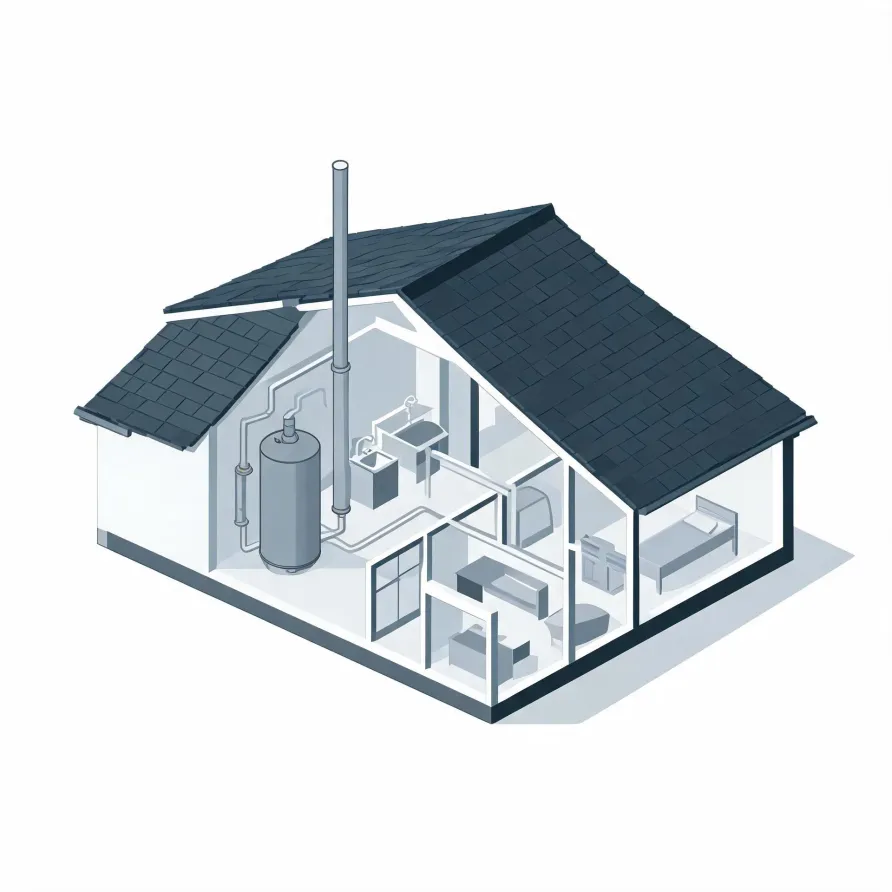
The tank or tankless unit is the centerpiece of the system, sitting in a utility room, basement, or closet, and its job is to heat and hold water until a fixture calls for it. A pressure relief valve mounts directly on the unit and releases if internal pressure climbs too high. The cold-water inlet and hot-water outlet connections are made at the top of the unit.
A dedicated supply line brings cold water in, and the hot-water distribution line carries heated water out to the rest of the house. A drain valve sits near the base of the tank, and the flue or venting assembly runs from the unit to an exterior wall or roof to carry combustion gases out.
The drawing shows a typical layout, and a licensed contractor determines exactly what applies to your home.
Find a contractor in Essex CountyEssex County, by the numbers
344 severe weather events were recorded in Essex County, Massachusetts between 2015 and 2024.
NOAA National Centers for Environmental Information, Storm Events Database, bulk CSV export, events 2015-01-01 through 2024-12-31.Half the homes in Essex County, Massachusetts were built in 1960 or earlier (2020-2024 ACS 5-year).
U.S. Census Bureau, 2020-2024 American Community Survey 5-Year EstimatesEssex County, Massachusetts holds 329,776 housing units (2020-2024 ACS 5-year).
U.S. Census Bureau, 2020-2024 American Community Survey 5-Year EstimatesOwners occupy 63.5% of the occupied homes in Essex County, Massachusetts (2020-2024 ACS 5-year).
U.S. Census Bureau, 2020-2024 American Community Survey 5-Year EstimatesSevere Weather Events in Essex County
Extreme weather puts real strain on water heating equipment, accelerating wear and pushing systems to meet demand they were not sized to ignore. How often that happens here shapes what a water heater in Essex County needs to handle over its life.
344 severe weather events, 2015–2024. Source: NOAA National Centers for Environmental Information, Storm Events Database.